Ohio Minority Supplier Development Council

Trend Watch: AI Is Getting Cheaper to Run. Infrastructure Is On Shaky Ground.

New efficiency breakthroughs could lower AI costs for everyone, but energy strain, grid limits, and war-driven supply disruptions will shape who benefits first.

by Jamie R. Van Doren

What’s Changed?

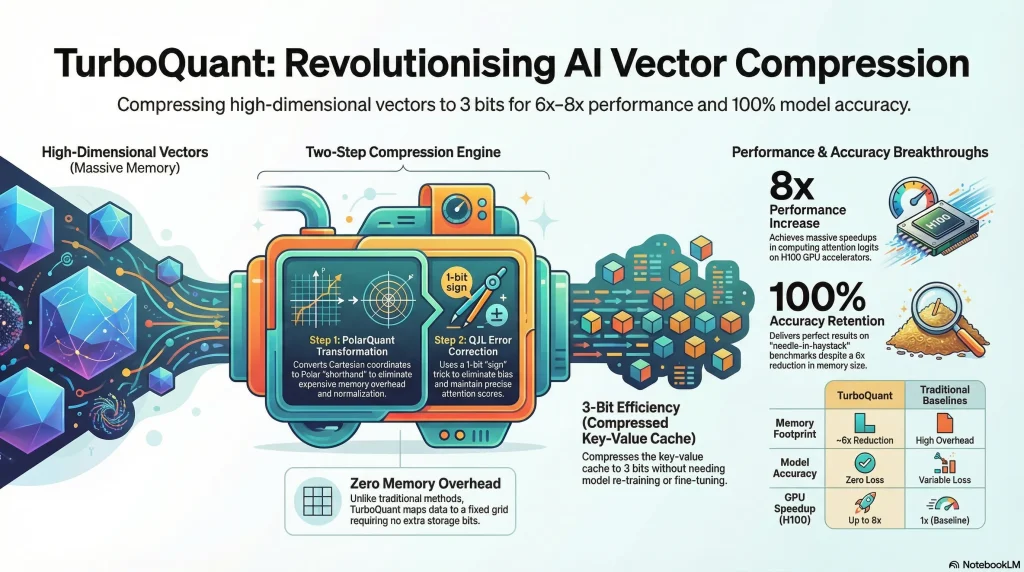
Last week, Google Research published a compression algorithm called TurboQuant that does something genuinely useful: it shrinks the working memory AI models need to operate — by roughly six times — without degrading performance. On Nvidia’s H100 chips, a version of the technique delivered up to an eightfold speedup in a key processing step. Memory chipmakers noticed. Within hours of the announcement, shares of Samsung, SK Hynix, and Micron all dropped, as traders recalculated just how much physical hardware the AI industry will actually need.

The internet, naturally, compared it to the fictional compression algorithm from HBO’s Silicon Valley. Fair enough. But the business implications are real.

TurboQuant is not an isolated event. It sits inside a broader pattern: AI models are getting smaller, faster, and cheaper to operate. Techniques like quantization, distillation, and compression have been steadily reducing the computing resources needed to run useful AI. What once required racks of specialized hardware is beginning to run on leaner setups: smaller cloud instances, edge devices, even laptops.

Google released TurboQuant under an open research framework, and community developers had already begun porting it to consumer-grade hardware within a day of the announcement. An official open-source release is expected in the second quarter of this year.

Full Credit Google Research

This is the efficiency side of the equation. And for smaller firms, it’s the side worth paying attention to.

But there’s also another side.

Why Does It Matter?

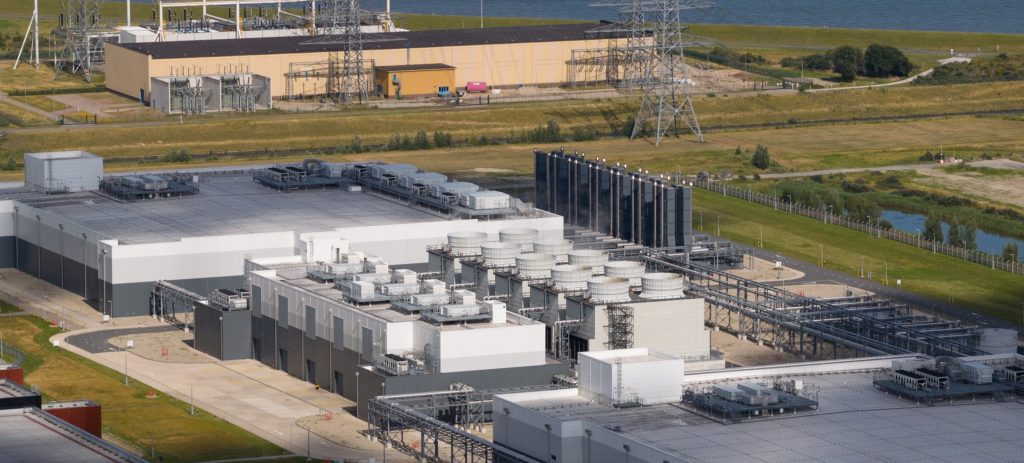
AI infrastructure is under strain. Not eventually. Right now. The U.S. Department of Energy projects AI energy demand will double or triple within the next few years, potentially reaching 12% of total national electricity consumption by 2028. The country’s largest grid operator, PJM Interconnection, which serves over 65 million people across 13 states, has warned it could be six gigawatts short of reliability requirements by 2027. For everyday Americans, that means being told not to run your air conditioner on the hottest day of the year. And if enough people ignore that request, it means rolling blackouts so the whole grid doesn’t go down.

Retail electricity prices have already risen more than 40% since 2019. Some of that is weather, regulation, and fuel costs. But data center demand is an accelerating factor, and utilities from Virginia to Ohio to Texas are scrambling to keep up.

Large tech companies are responding by locking in long-term energy contracts, investing directly in power generation, and competing for grid capacity in ways that smaller firms simply cannot replicate. Meta recently committed up to $27 billion in a single deal for dedicated compute infrastructure. Google, Microsoft, and Amazon are collectively planning hundreds of billions in data center capital expenditure through the end of this year alone.

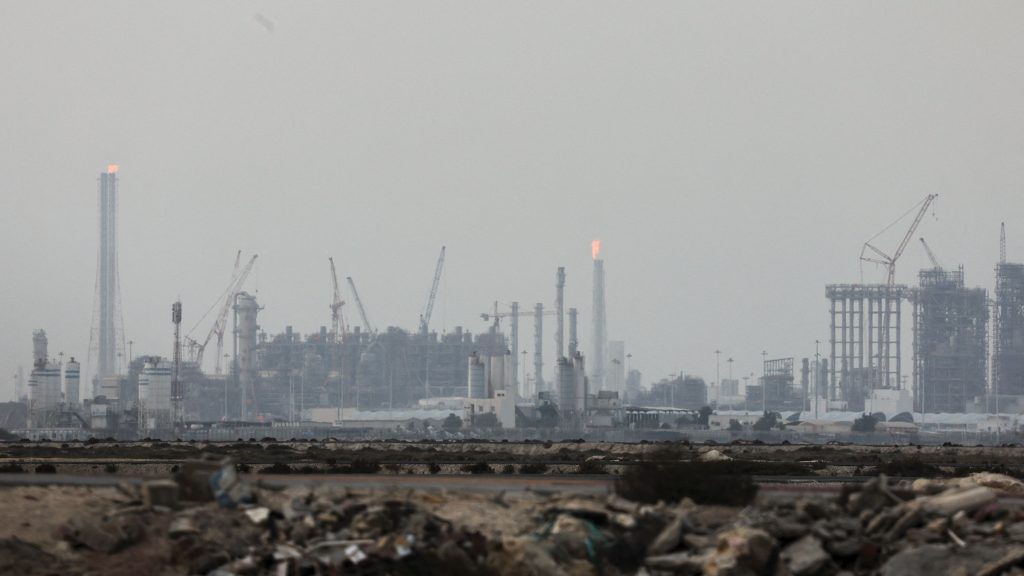
There’s a less obvious ripple, too. Iranian strikes on Qatari gas infrastructure have knocked out roughly a third of global helium production — a gas most people associate with party balloons but that chipmakers need to manufacture the semiconductors AI runs on. Without helium, you can’t etch the chips that power data centers. Software can get more efficient, but it still needs hardware, and that hardware supply chain just got more fragile. Cheaper algorithms don’t help much if you can’t build the machines to run them on.

So, here’s the tension. AI is getting cheaper to run, yes. But the infrastructure that supports it is getting more expensive and much more constrained. Energy costs are climbing. Grid capacity is tightening. And now, war-driven supply chain disruptions are threatening the materials needed to build the hardware itself. Efficiency improvements like TurboQuant help at the software layer, but software runs on chips, chips run on power, and both of those supply chains just got more complicated. The bottleneck isn’t the algorithm anymore. It’s, well… everything else.

For MBEs, this creates a two-sided opening.

The opportunity: If useful AI tools require less memory and less compute, the cost of adoption drops. You don’t need a massive technology budget to use AI well. You don’t need to build anything from scratch. The tools that help you write faster proposals, run quicker competitive analysis, automate reporting, and tighten forecasting are getting better and cheaper at the same time. That lowers the barrier to entry in a meaningful way.

The risk: Infrastructure advantages compound. Companies that can secure compute capacity, negotiate energy contracts, and invest ahead of demand will operate with structural advantages that have nothing to do with intelligence or effort. If energy costs keep climbing and grid access remains uneven, operational resilience becomes a competitive differentiator, not just a nice-to-have.

It’s worth repeating on point in particular: recent war-driven energy shocks are a reminder that technology growth doesn’t happen in a vacuum. As oil, power, and materials markets tighten, operational resilience matters just as much as innovation. The AI economy depends on the physical economy, and the physical economy is under pressure from several directions at once.

What Should You Do?

For MBEs: focus on disciplined adoption, not ambition.

The advantage right now isn’t in building custom AI. It’s in applying existing tools to real bottlenecks. The companies that benefit won’t necessarily be the ones experimenting casually. They’ll be the ones building repeatable workflows with clear outputs and measurable time savings.

Where are you spending hours on work that a well-configured AI tool could cut by a third? Proposal drafting, compliance documentation, market research, internal reporting? These aren’t glamorous use cases, but they’re the ones that actually change how a small company operates day to day.

The right question isn’t “Are we using AI?” It’s “Can we point to specific outcomes that improved because of it?” If the answer is vague, the implementation isn’t working yet.

For corporate members: start looking at efficiency as a signal.

A supplier using AI well may not look different on a capabilities slide. But they’ll be more responsive. Their documentation will be cleaner. Their turnaround will be faster. Their communication will be more consistent. These are observable differences, and they’re worth weighting in supplier evaluation.

As AI becomes more accessible, the gap won’t be between companies that use it and those that don’t. It will be between companies that use it with discipline and those that treat it as a novelty. That distinction will show up in execution long before it shows up in an RFP/RFQ response.

OMSDC’s Upcoming AI Workshop Series

The Ohio Minority Supplier Development Council (OMSDC) is developing a practical AI series for MBEs and others. We want to hear what formats and topics would actually be useful. Take the short survey at the link below. Complete it and you can download the Competitor Analysis AI Workflow one-pager, a step-by-step guide with prompts and instructions you can put to work immediately.

Take the survey and download the workflow

Questions Worth Asking

For MBEs:

  • Where are you spending time that could be reduced by 30–50% with the right tools? And have you actually tested that?
  • Are you building repeatable AI workflows, or relying on ad hoc experimentation?
  • If energy and compute costs rise, does your operating model stay viable?

For corporate members:

  • Are your suppliers becoming measurably more efficient over time, or staying flat?
  • Are you evaluating responsiveness and operational clarity, or just price and scale?
  • How do you identify partners who are quietly improving their operations through technology?

For both:

  • If AI becomes cheaper and more accessible, what differentiates you?
  • If infrastructure becomes more constrained, how do you stay flexible?

The Takeaway

The efficiency race in AI is real. And it favors smaller, disciplined adopters more than most people realize. But it’s happening against a backdrop of physical constraints, energy, grid capacity, supply chain friction, that won’t resolve quickly. The companies that navigate both sides of that equation, getting leaner on the software side while staying resilient on the infrastructure side, are the ones best positioned for what comes next. The most advanced AI won’t necessarily be the differentiator. The most disciplined use of it will be.

OMSDC 2026 Annual Meeting Builds Momentum for Businesses in the Region

by Jamie R. Van Doren

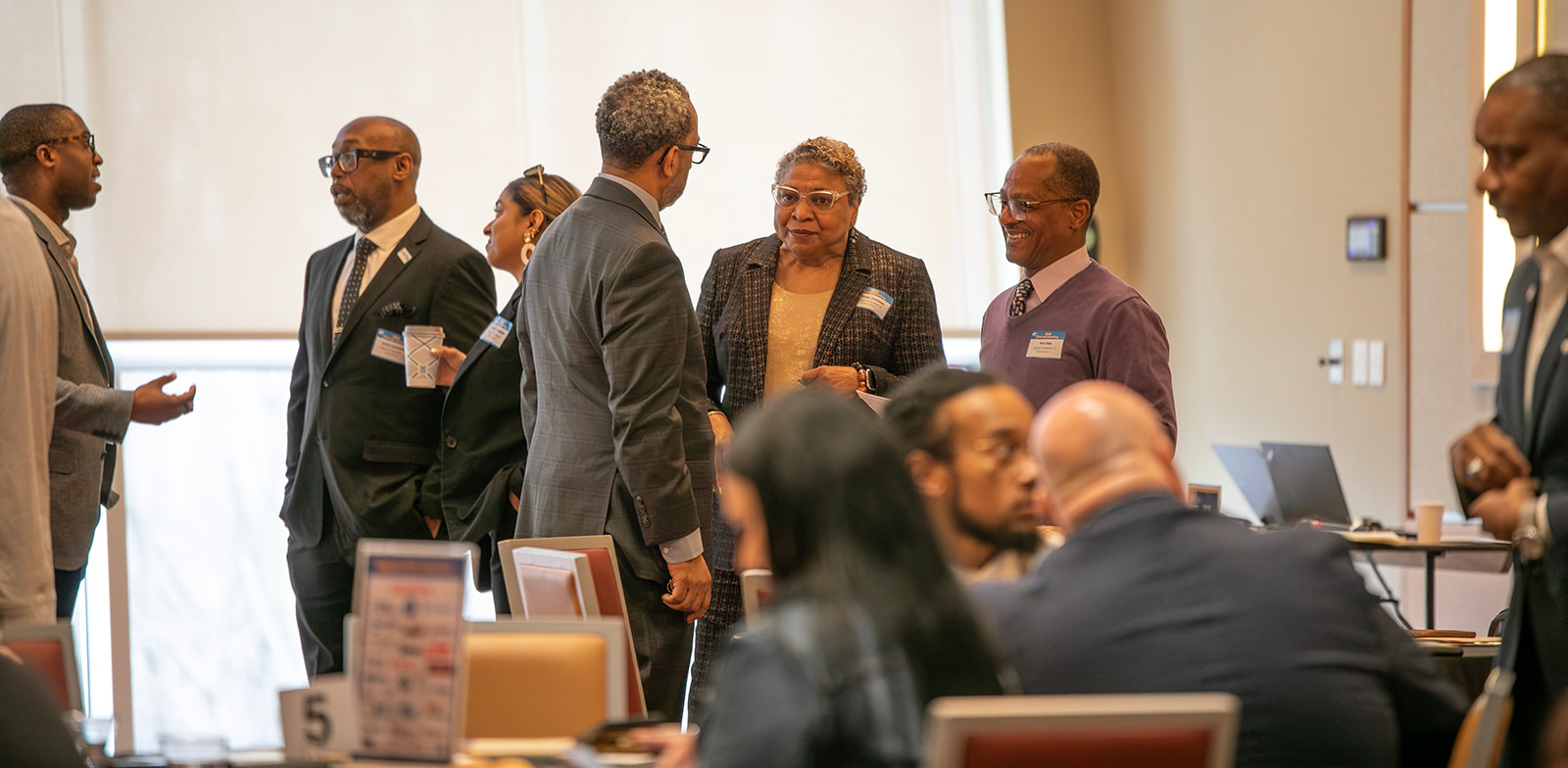
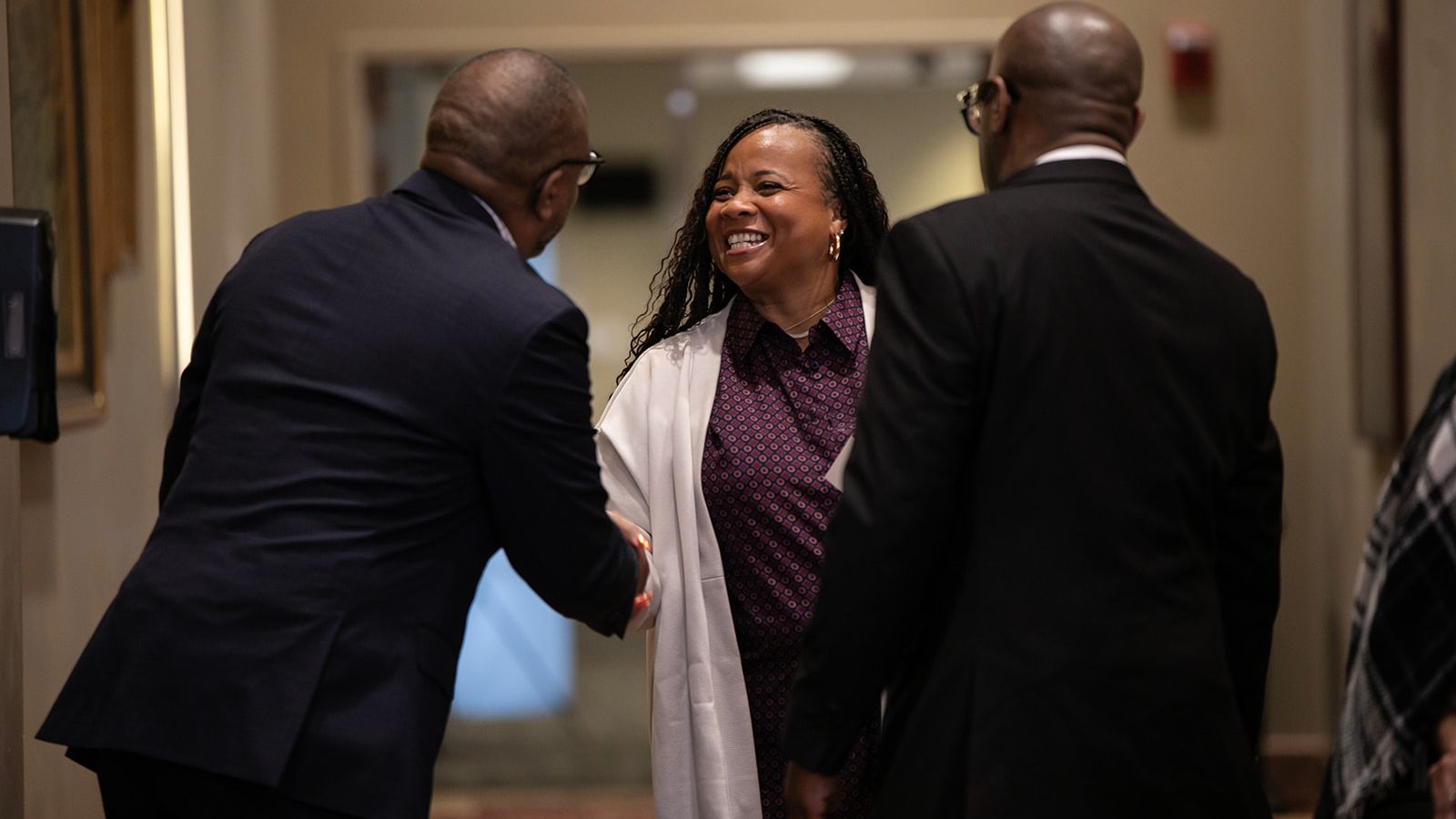
On March 19, leaders from across Ohio gathered at Central State University in Wilberforce for the 2026 OMSDC Annual Meeting. Corporate executives, certified minority business owners, community partners, and regional officials filled the room for a program grounded in a single consistent idea: that the work of building stronger businesses and more connected supply chains is not a matter of goodwill alone. It is a matter of strategy, discipline, and follow-through.

The theme was Building Bridges to Economic Equity. By the end of the day, it felt less like a slogan than a working description of what was actually happening in the room.

President and CEO George R. Simms opened with an honest account of where OMSDC stands. The prior year brought real headwinds. 2026 is being approached differently — with sharper focus on three areas: advocating for supplier inclusion as a measurable business outcome, improving the quality of connections between corporate members and certified MBEs, and building the capability of minority businesses to compete, deliver, and scale. The language is familiar. The discipline is being treated as new.


“Unbelievable.”

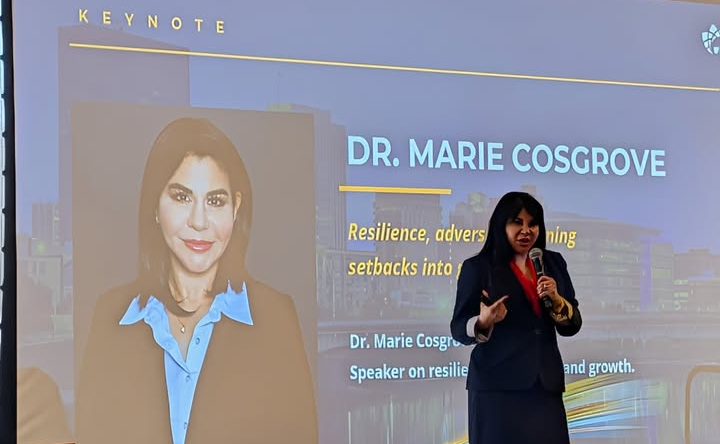
Dr. Marie Cosgrove, PhD, resilience expert and author of Greater Fortune: Essential Lessons from the Entrepreneur Who Bought the Company That Fired Her, delivered the keynote, and she opened with a question that everyone in business gets asked constantly. How is business?

Her answer was a single word. She said it, and she asked the room to say it with her: Unbelievable.

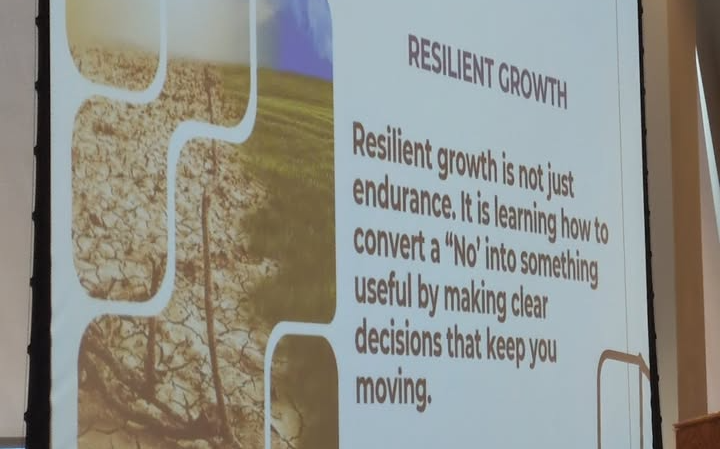
Not as a deflection. As a philosophy. Business is better than you ever imagined? Unbelievable. You are in the hardest stretch of your professional life? Also unbelievable. The word holds both, and that is precisely the point. The way you frame your circumstances shapes what you are able to do with them — and that framing is a choice you make, not a condition you inherit.

Dr. Cosgrove has earned that philosophy at close range. She shared the story of her own birth, which began with her mother’s survival of a devastating car accident in Mexico. The injuries were severe enough that doctors recommended removing her from life support. During her mother’s recovery, they also advised against continuing the pregnancy. Her mother refused both recommendations. She woke up. She carried the pregnancy to term. Dr. Cosgrove described this not simply as a miracle, but as the foundational act of tenacity that has defined her life’s work. The story carries a theological dimension she does not shy away from: hope, she told the room, is not something that precedes faith. They are the same thing. They are an orientation toward the possible, available even when the evidence points the other way.

The professional chapter of her story lands with equal force. She was a single mother of four when she pleaded for a commission-based sales position at balanceback™, a medical device company. She got the job. She was later fired. Not for underperforming, but for making too much in commissions. When the company told her to accept a pay cut, she declined. She was let go. Rather than treating the firing as a verdict, she treated it as a moment of forced reflection. She started her own company. Two years later, she bought balanceback™. Skeptics predicted she would bankrupt herself and the company within six months. Today, balanceback™ is recognized as a world leader in fall prevention and brain and balance disorder diagnostic and treatment devices.

The point she kept returning to was not that everything works out. It is that setbacks, handled with intention, create the conditions for a different kind of growth than ordinary progress ever requires.


Hardwiring Inclusion to Results

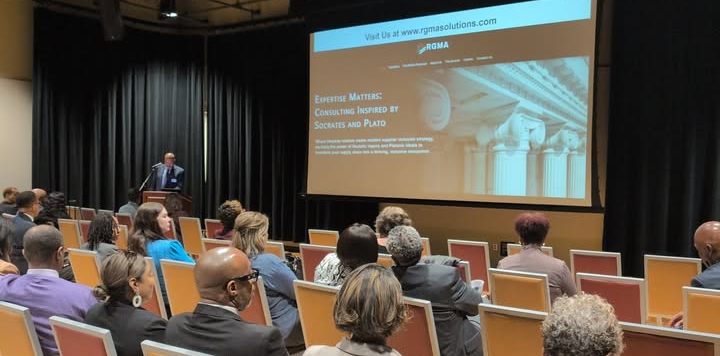
The Corporate Impact Lab was led by Ralph G. Moore, President of RGMA, a Chicago-based firm that has spent more than four decades helping corporations build supplier inclusion strategies that hold up to scrutiny. His session addressed a question that quietly frustrates a lot of supplier inclusion work: how do you actually measure it, and how do you make the case to leadership when the numbers have to compete with every other priority on the table?

Moore’s argument cut through the usual framing. This is not a conversation about good values. It is a conversation about shareholder return. Minority consumers represent the fastest-growing market segment in the United States. The gap between what corporations spend with minority suppliers — roughly two percent of procurement — and the share of future consumer revenue growth driven by minority households — projected at thirty to fifty percent — represents a material business risk, not just a missed opportunity. Supply chain resilience, innovation capacity, pricing competitiveness, and community purchasing power all connect back to inclusion in ways that can be measured and communicated in terms that survive a budget cycle.

For nonprofits and mission-driven organizations, Moore made clear that the same logic applies at a different level. Supplier inclusion is not adjacent to mission. It is a direct expression of it, and it can be documented as such.

His session gave corporate attendees a framework for bringing that conversation to their own leadership — and gave MBEs a clearer picture of how to position their value in terms that resonate on the other side of the table.


Working Smarter

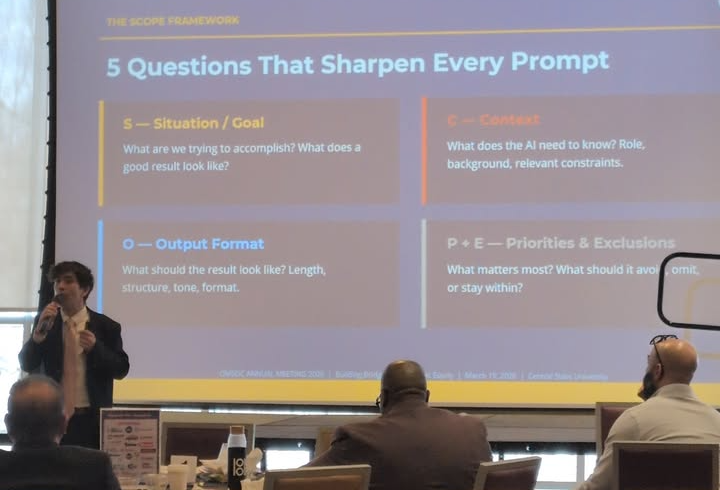
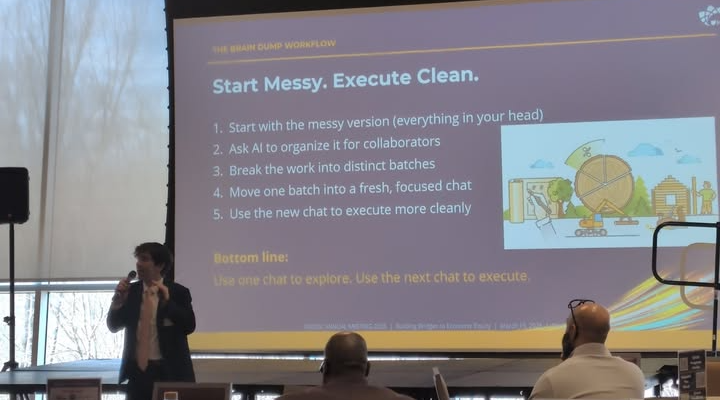
The MBE Impact Lab, facilitated by OMSDC’s Jamie Van Doren, focused on artificial intelligence as a practical business tool. The session addressed both the real risks of AI use (including context degradation, output drift, and the hard limits of machine judgment) and a working framework called SCOPE for structuring AI workflows in ways that produce more reliable, more usable results. Central to that conversation was a simple but counterintuitive principle: one chat, one job. Keeping each AI conversation focused on a single task, rather than letting a thread accumulate instructions, pivots, and prior outputs. The practice significantly reduces drift and hallucination while producing results that are more accurate and enterprise-ready.

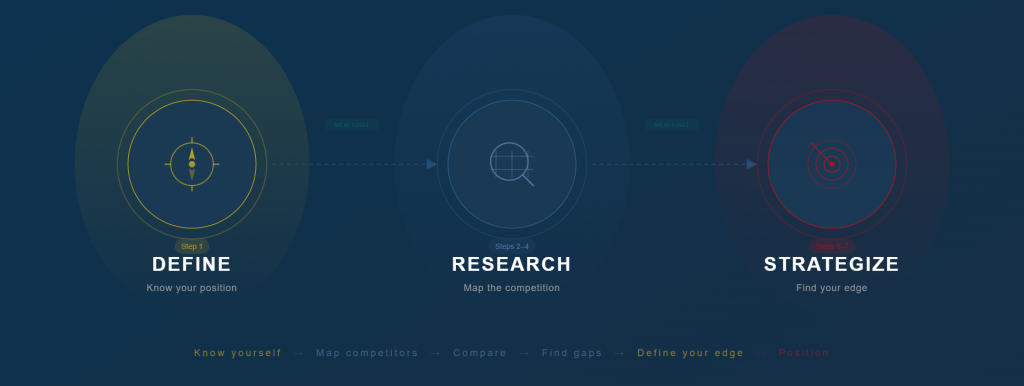
Van Doren walked participants through a few steps of a live competitor and market analysis, using AI to map a competitive landscape, surface positioning opportunities. The ultimate outcome of the analysis being to help companies develop the kind of differentiation language that makes a corporate introduction land. The goal was direct: help MBEs ask for more, and give them something they could use the next morning.

That session was a first chapter, not a full course. OMSDC is developing a practical AI series for MBEs, and we want to hear what formats and topics would be most useful. A short survey is available at the link below. Those who complete it can download the Competitor Analysis AI Workflow one-pager — a step-by-step guide with detailed prompts and workflow instructions you can put to work immediately.

Take the survey and download the workflow


Connections Made Intentional

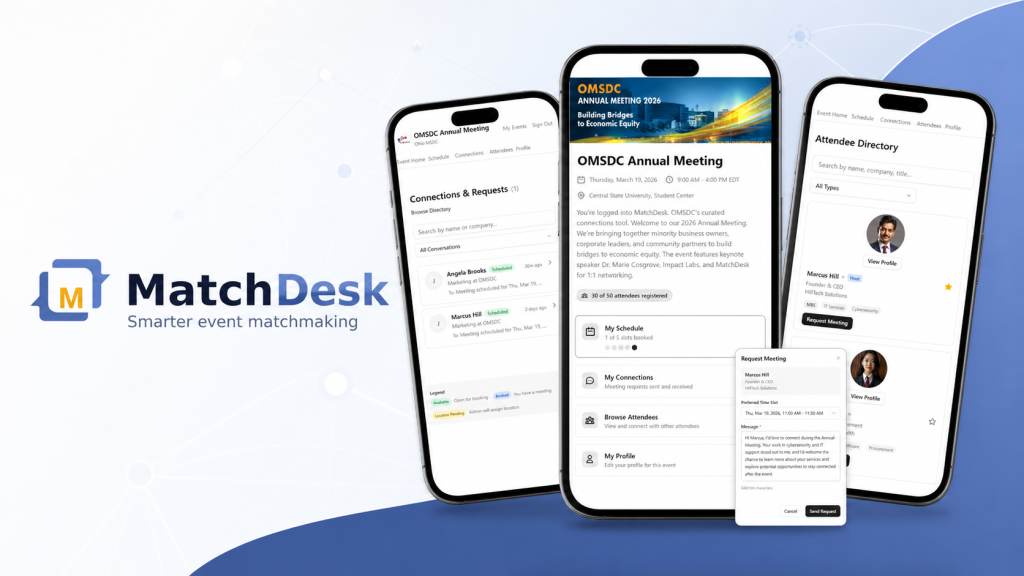
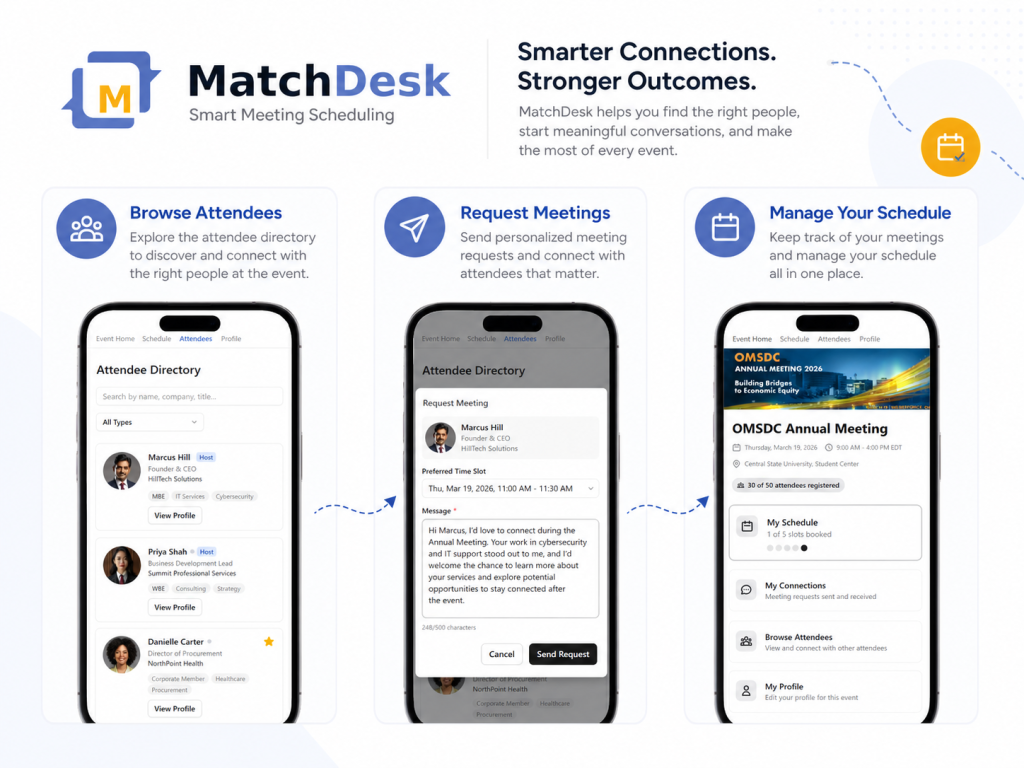
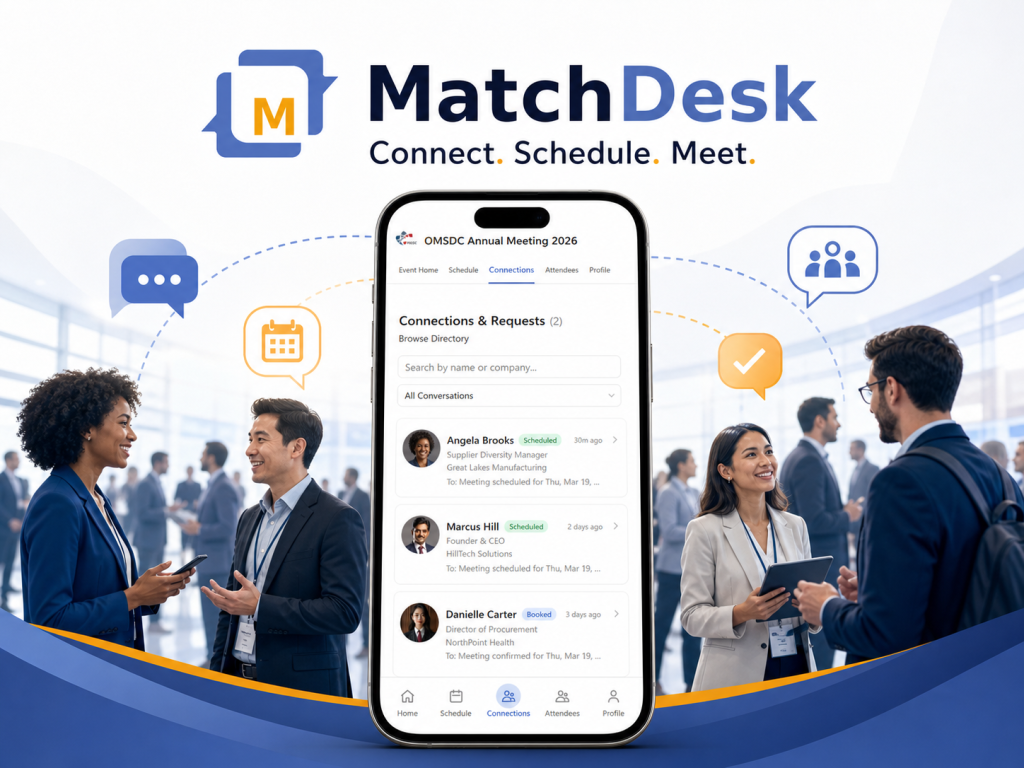
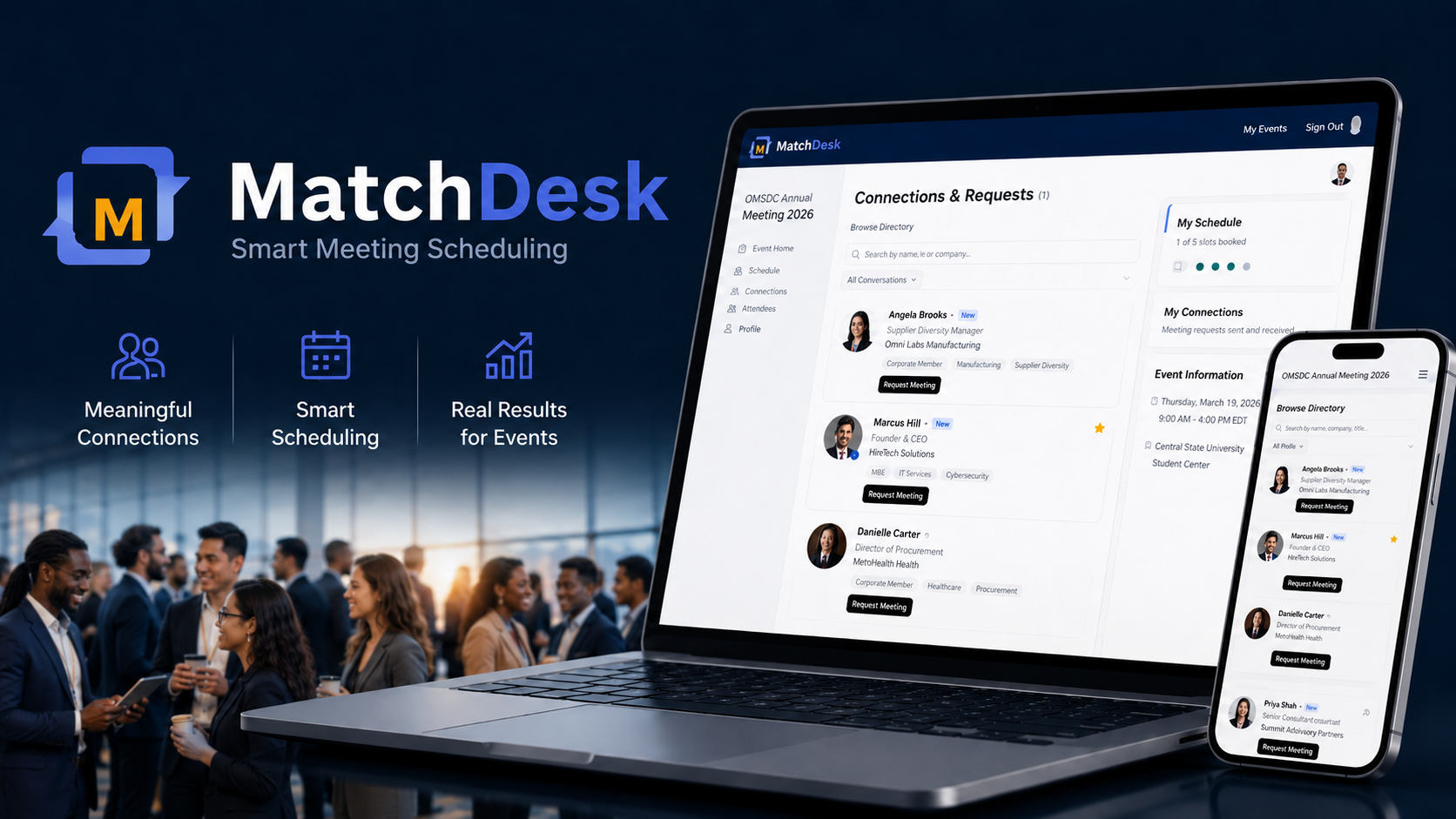
The afternoon also included the first pilot of MatchDesk, a curated one-on-one networking platform built to replace the randomness of open networking with something more deliberate. Forty-eight pre-scheduled meetings took place across the session. Not every introduction becomes an opportunity. The goal is to keep raising the number that do.

The Networking Reception, hosted by the Dayton Area Chamber of Commerce, gave the room space to continue what the structured sessions had started. Some of the most useful conversations of the day happen in those margins.

Learn more about MatchDesk, and if it’s right for your next event.


Thank You to Our Sponsors

The annual meeting doesn’t happen without the organizations willing to invest in it, and this year’s sponsor community reflected genuine commitment to the work.

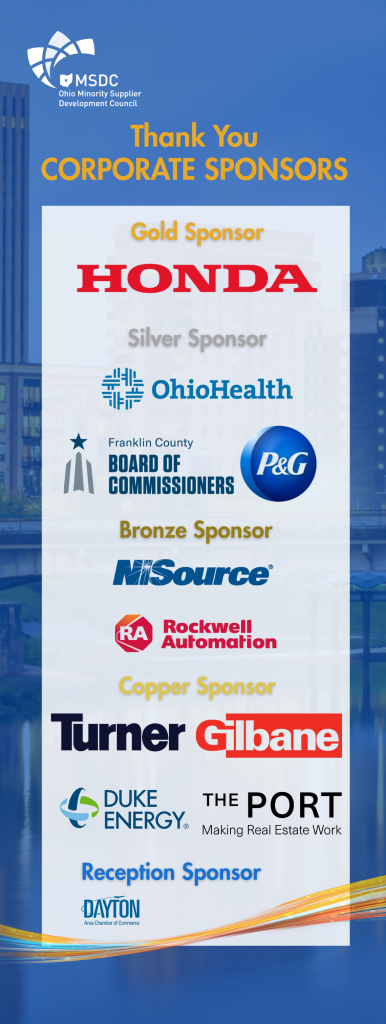
Honda anchored the program as the Empowerment Bundle Sponsor. Advancement Bundle Sponsors Franklin County Board of Commissioners, OhioHealth, and P&G provided essential program-level support. Investment Bundle Sponsors NiSource and Rockwell Automation, along with Advocate Bundle Sponsors Duke Energy, Gilbane, Turner Construction, and the Port of Greater Cincinnati, each contributed to making the day possible.

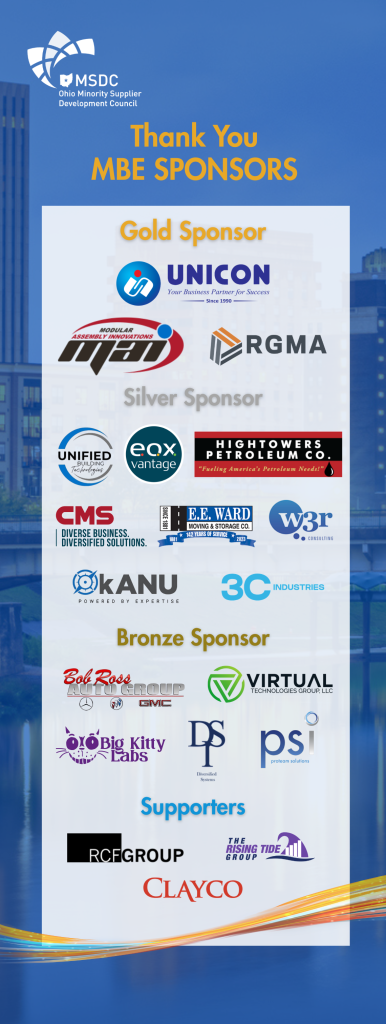
The investment of OMSDC’s own MBE community was equally visible. Vanguard Sponsor Unicon, Trendsetter Sponsors Commodity Management Services, EE Ward, EOX Vantage, Hightower Petroleum Co., kANU Investments, and Unified Building Technologies, and Innovator Sponsors Big Kitty Labs, Bob Ross Auto Group, Diversified System, and Virtual Technologies Group all brought meaningful support to the table. Supporter sponsors RCF and The Rising Tide Group rounded out the community. A note of appreciation as well to MAI, 3C Industries, and W3R, whose conversations about partnership reflect the kind of ongoing engagement that builds something over time.

The Dayton Area Chamber of Commerce hosted the Networking Reception. Capitaved Impressions documented the day.

The conversations that began in Wilberforce will continue. That’s the point of our work.

2026 Annual Meeting

You’re Invited: March 19, 2026

Central State University, Wilberforce, OH

OMSDC’s Annual Meeting is our signature convening for minority business leaders, corporate executives, community partners, and other key stakeholders from across Ohio. It is where we take stock of the year, share what is working, and align on the priorities that will drive real outcomes in the year ahead.

This is also a milestone moment for OMSDC. We highlight measurable impact. We recognize leadership. We surface practical opportunities that strengthen supplier diversity and expand economic participation.

Expect a focused, high-energy day built around meaningful conversations, strategic updates, and networking designed to lead to action. If you are a long-time partner, you will leave with clarity and momentum. If you are new to OMSDC, you will leave with context, connections, and a clear sense of how to engage.

For full details, visit the Annual Meeting Event Page.

We look forward to welcoming you for an engaging, outcomes-driven Annual Meeting.

2025 OMSDC Annual Awards Gala

Date: Friday, November 21, 2025 (Evening program + After Party)
Venue: Hilton Cleveland Downtown (capacity ~500)
Host: Ohio Minority Supplier Development Council (OMSDC)

Buy TicketsNominate for AwardsBecome a SponsorWhat to Wear

Why Attend

This year’s Gala is more than a celebration—it’s a statement. Supplier diversity remains a proven engine for growth and resilience. When buyers, MBEs, community leaders, and policymakers gather in one room, opportunity follows. We’re expanding the tent to 500+ attendees to recognize excellence, build new relationships, and advance inclusive economic growth across Ohio. Be in the room were connections and decisions will happen with Ohio’s top business executives, community leaders, policy makers, and others.

What to Expect

  • Reception & Networking with Ohio’s top decision-makers and executives, including corporate buyers, MBEs, and civic leaders
  • Awards Ceremony honoring outstanding corporations, MBEs, and community partners
  • After Party—music, photos, and connections that carry into Monday
  • Dress Code: Formal / Black-Tie Optional or Upscale Wonderland-Inspired Costume (masks optional). Think elegance first, whimsy second. See our What to Wear Guide.

Award Categories

Corporate Awards

  • Corporation of the Year (by sales class)
  • Buyer of the Year
  • Advocate of the Year

MBE Awards

  • Supplier of the Year (Class I–IV)
  • Emerging Business of the Year
  • Legacy Business of the Year

New in 2025 — Community Awards

  • Community Impact Award
  • Policy & Advocacy Award
  • Youth Entrepreneurship Award

Eligibility: Nominations welcome from OMSDC members, certified MBEs, community partners, chambers, and allied organizations. Self-nominations allowed.
Deadline for Community Partner Awards: Friday, October 17, 2025 at 11:59 p.m.
Submit a Nomination

Program Timing (subject to final run-of-show)

  • 5:30 p.m. | Registration & Reception
  • 6:45 p.m. | Welcome & Opening Remarks
  • 7:00 p.m. | Dinner & Awards Program
  • 9:15 p.m. | After Party
  • 10:45 p.m. | Closing

Tickets & Tables

General Admission (Corporate/Community): $450
OMSDC Corporate Partner: $400
MBE (OMSDC Certified): $200
MBE (Unaffiliated): $250
Corporate Table (10 seats): $3,600

Sponsorship Opportunties

  • Title Sponsor — $15,000 (“Presented by,” brief welcome remarks, top placement)
  • Award Sponsor — $10,000
  • After Party Sponsor — $7,500
  • Reception Sponsor — $5,000
  • Red Carpet Sponsor — $3,500
  • MBE-Only Market Sponsor — $1,000

Program ads (print): $250 full page$175 half (horizontal)

To reserve a sponsorship package, and ad, or to customize benefits: Become a Sponsor or email anagel@ohiomsdc.org.

Community Partner Toolkit

We offer rolling promo codes (expire October 31, 2025) that provide discounts off of our General Admission Tickets, as well as co-branded assets for chambers, foundations, nonprofits, and associations.
Example codes: UNITY25, IMPACT25, GROWTH25, EQUITY25, COLLAB25, STRONGER25.
Request your toolkit today: jvandoren@ohiomsdc.org.

Accessibility & Inclusion

Hilton Cleveland Downtown is ADA accessible. Please indicate dietary or accessibility needs during checkout or contact kmanigault@ohiomsdc.org.

FAQs

What’s the dress code?
Formal / Black-Tie Optional or Upscale Wonderland-Inspired Costume. Masks optional. See What to Wear.

Will the event sell out?
We expect a full house. Secure tickets early.

Are donations accepted?
Yes. Make a tax-deductible gift via our Donation Page.

Questions?
Email marketing@ohiomsdc.org or call 614.225.6959.

The 2025 ConnectingOHIO Expo in Columbus

Step Into Possibility at the 2025 ConnectingOHIO Expo!
Columbus, OH | August 4-6,2025

ConnectingOHIO 2025 is just around the corner, and if you’re serious about accelerating growth, driving deal flow, and shaping the future of Ohio’s economy, these three powerhouse sessions should be on your calendar.

Whether you’re a corporate buyer, a certified MBE, or a community leader invested in inclusive economic development, these are the moments where relationships are built, ideas are sparked, and opportunities are realized.

Can’t Attend the Full Expo? Signature Sessions Are Also Available À La Carte.

Register Now or Learn More About the Agenda

DAY 1

DAY 2

DAY 3

Keynote Speakers

  • Luke Fedlam – Nationally recognized attorney and advisor to athletes and entrepreneurs (Day 1)

  • Kala Gibson – NMSDC Board Chair and national champion for economic equity (Day 2)

Why Attend?

  • Meet buyers from 40+ leading companies across healthcare, utilities, construction, finance, and more

  • Connect with MBEs and entrepreneurs building scalable, innovative businesses across Ohio

  • Learn from leaders through panels, pitch competitions, and real conversations—not just presentations

  • Build real partnerships that move our local economy forward

Whether you join us for the full experience or select key sessions, ConnectingOHIO is your gateway to opportunity.

Register Now or Learn More About the Agenda

ConnectingOHIO Promo Video by OhioMSDC

Register Now or Learn More About the Agenda