Ohio Minority Supplier Development Council

When “This Isn’t Scalable” Becomes a Product: How OMSDC Built MatchDesk to Stop Leaving Its Best Connections to Chance

OMSDC’s curated networking platform started as a frustration, survived a health scare, and became a case study in how mission-driven organizations can build tools that serve their members and sustain their work.

Jamie Van Doren was supposed to help organize and run DealMaker at ConnectingOHIO 2025. He had a plan. It was analog, but it was a start.

On April 30, he had a heart attack. More than one, actually. On May 11, he went under for a triple bypass.

He came back in late June, just in time to help support the event. And what he saw was a team working incredibly hard to do something that shouldn’t have been so difficult. Every curated meeting between a corporate member and an MBE supplier ran through emails, spreadsheets, and the institutional knowledge of one person trying to match 400-plus MBEs to specific corporate needs. The follow-up alone was a full-time job. The matching was well-intentioned but limited by what any single person can hold in their head.

“This isn’t scalable,” Van Doren remembers thinking. “And it isn’t just an efficiency problem. It’s a mission problem. If we can’t connect the right people reliably, we’re leaving our most important value on the table.”

From Pitch to Product

By January 2026, Van Doren had an idea he wanted to test. OMSDC’s Annual Meeting was coming up in March. Open networking is a staple of events like it, but open networking leaves outcomes to chance. The people who need to meet each other often don’t. The introverts hang back. The time runs out. The most valuable conversations happen accidentally or not at all.

Van Doren had experienced a better model years earlier. While fundraising for his first tech startup in 2020 and 2021, he’d used a curated virtual meeting platform that scheduled one-on-one sessions with venture capital firms. The structure worked. Every meeting was intentional. Every slot was used.

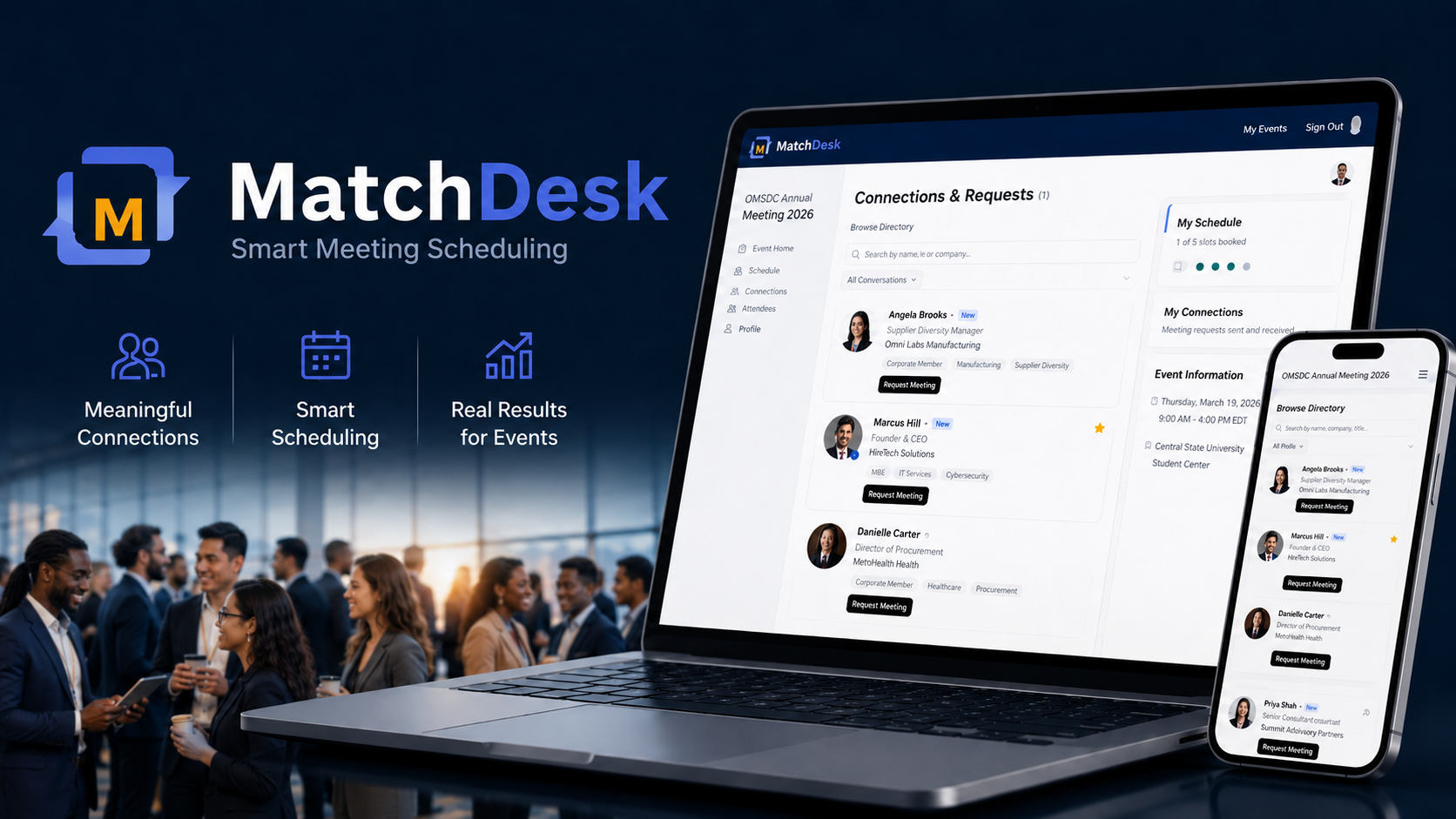
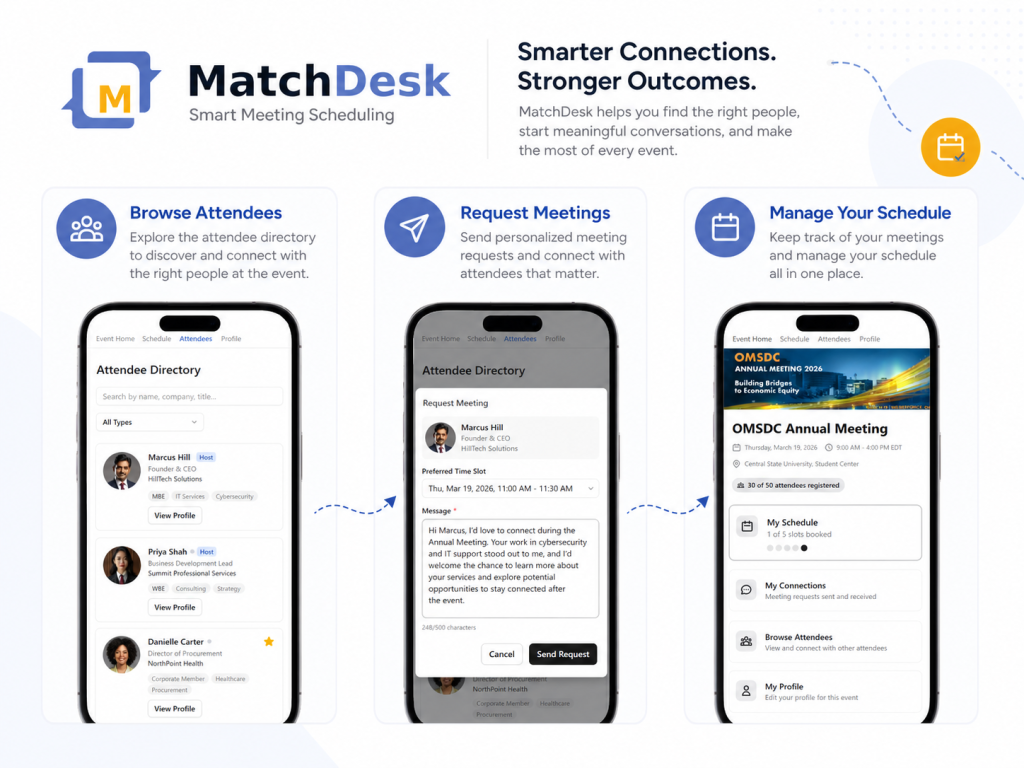
He pitched the concept to OMSDC’s leadership: a curated one-on-one networking platform for the Annual Meeting. Attendees would browse a directory, request meetings with specific people, and both parties would opt in before anything was scheduled. The system would then generate a conflict-free schedule automatically. No spreadsheets. No email chains. No collisions.

The team decided to trust him. George Simms, OMSDC’s President and CEO, saw something beyond a scheduling tool. “This is what supplier inclusion looks like when it’s hardwired into the way we operate,” Simms says. “We talk about connecting minority businesses to opportunity. This is infrastructure that makes that connection structured and repeatable, not something that depends on who happens to be standing next to whom at a reception.”

Simms also saw a broader signal. Van Doren is a Latino tech founder building enterprise software with AI tools, inside a minority business support organization. “That’s the kind of innovation and excellence we exist to spotlight,” Simms says. “It’s one thing to advocate for minority-owned businesses. It’s another to have one of our own people build the tool that solves the problem.”

Building It: AI as Developer, Not Magic Wand

Van Doren looked into off-the-shelf solutions first. The pricing was a non-starter. Competitors charge $3,000 to $10,000 or more per event. For a nonprofit running multiple events a year, those numbers don’t work. And Van Doren wasn’t convinced the features would match what OMSDC actually needed.

So he decided to build it himself. Not from scratch in the traditional sense, but not with a wave-of-the-hand prompt either. Van Doren has built two tech companies, led developer teams, and co-founded a company in 2020 called NeverEnding. They were building a custom AI model for animation, before the large language model wave hit the mainstream. He knew how to put together a product requirements document and a technical roadmap. The difference this time was the developer: Claude Code.

“Using AI to code isn’t like how they advertise it,” Van Doren says. “Not if you want something stable, scalable, and enterprise-ready. You can’t just say ‘build this app.’ Our platform needed real security, complex scheduling logic, multi-tenant architecture, role-based access. So we built it the way you’d build any serious software product: with a PRD, slice by slice, with multiple rounds of testing and deployment.”

Even with AI as the developer, the build was intense. Two months of ten- to twelve-hour days, seven days a week, reviewing and testing code daily. That’s not the effortless “just prompt it” story that AI marketing likes to tell. But it’s dramatically faster than the six to eight months the same product would take a team of two or three developers plus a project lead. The difference isn’t that AI eliminates the work. It’s that it compresses a team’s worth of output into one person’s timeline, as long as that person knows how to structure and lead a build.

James Price, OMSDC’s Associate Vice President of Operations, sees MatchDesk as evidence of OMSDC walking the walk. “We tell our MBEs they need to be looking at where AI fits in their organizations and how they can leverage it to compete,” said Price. “Creating MatchDesk is a perfect example of us not just telling, but showing.”

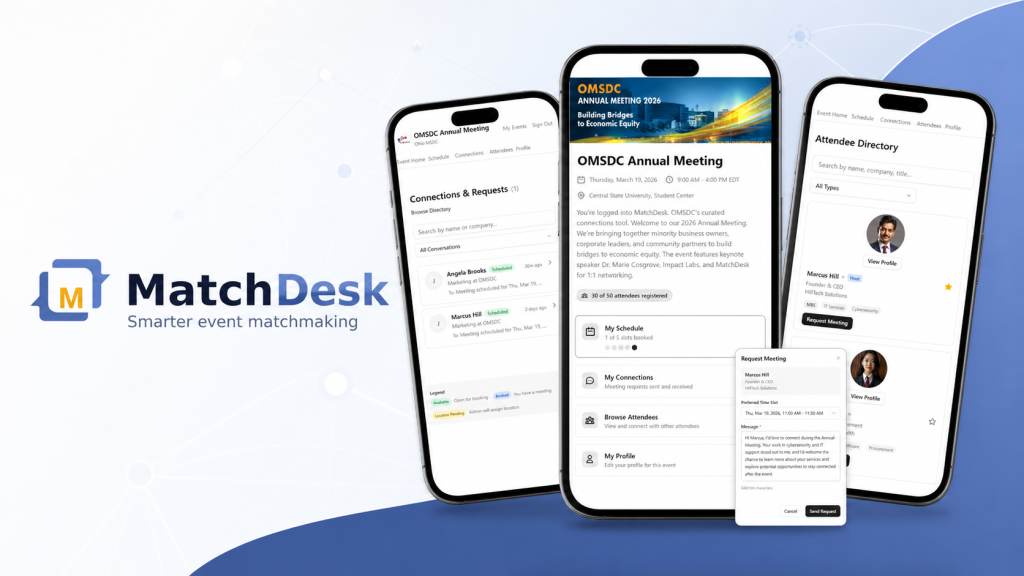
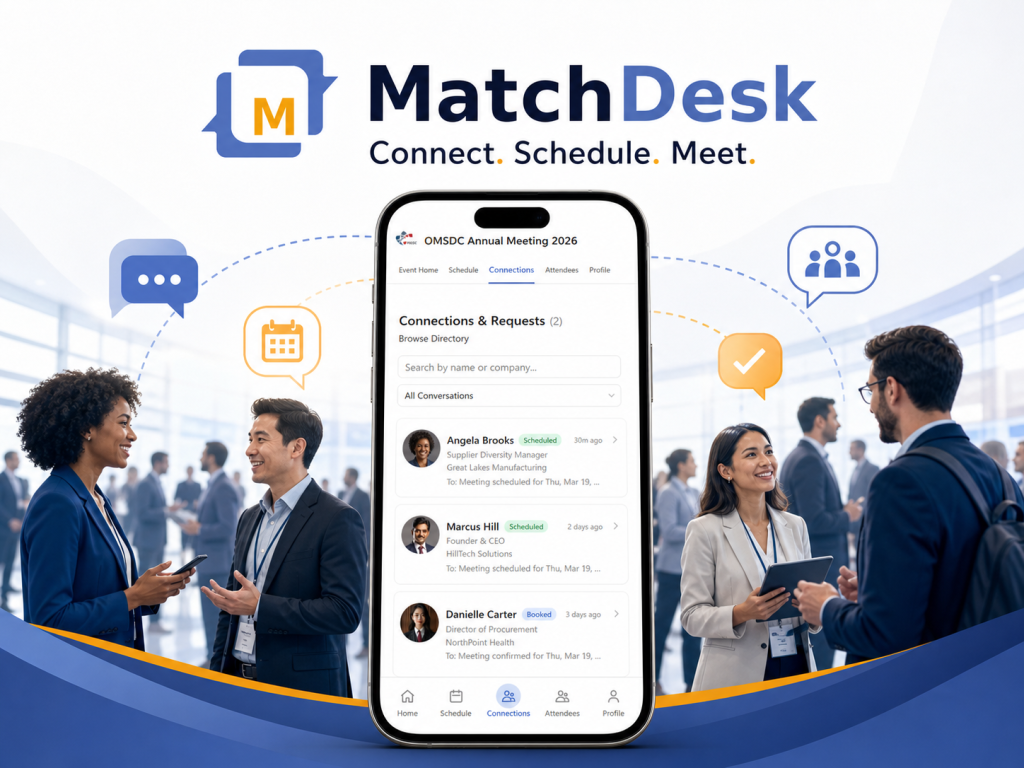
Here’s what it looks like in practice. MatchDesk is a 1:1 meeting scheduling platform designed for B2B events. Attendees browse a branded directory, send meeting requests with a personal message, and both sides confirm before anything is booked. The system then generates a conflict-free schedule for every participant. Organizers get real-time analytics on enrollment, meeting rates, and engagement.

Critically, Van Doren didn’t build MatchDesk just for OMSDC. It’s a multi-tenant system, meaning any organization — chambers of commerce, councils, accelerators, trade associations — can create an account, brand it to their identity, and run structured networking events through the platform. Pricing starts with a free tier and scales to $499 per year for enterprise use, a fraction of what incumbents charge per single event.

The First Deployment: Honest Lessons

MatchDesk launched at OMSDC’s 2026 Annual Meeting at Central State University. Signups were strong. But the event ran behind schedule, and as a result, fewer live meetings happened than were scheduled. The gap between scheduled and completed meetings surfaced a real operational lesson: structured matchmaking only works if the event itself protects the time it needs.

“It actually elevated something important for us,” Van Doren says. “We were packing too much in. The tool did what it was supposed to do. But we learned that if we want curated meetings to deliver, we have to give them room to breathe on the agenda.”

Price sees the tool as a way to shift where his team spends its energy. “Before MatchDesk, facilitating introductions between corporate members and MBEs meant a lot of manual coordination. Emails, spreadsheets, follow-ups. It worked, but it consumed time that could have gone toward building deeper relationships and solving real problems for our members,” Price says. “What excites me is getting out of the administration business and into the relationship business. I want our team focused on connecting people and creating value, not managing spreadsheets.”

The Bigger Thesis: Why Nonprofits Need to Build

Behind MatchDesk is a larger argument about how mission-driven organizations sustain themselves.

Most nonprofits operate at the mercy of a few revenue streams: donations, sponsorships, membership dues, and grants. One or two bad years can be devastating. And even in good years, there’s often not enough funding to do the work the organization knows needs to be done. For many non-profits, the mission is clear. The resource opportunities to fulfill it are not.

Van Doren believes nonprofits have an underexplored path: building products and services that create genuine member benefit while also generating revenue. Not merchandise. Not another gala tier. Real tools that solve real problems for the people the organization serves.

“Nonprofits are mission-driven,” Van Doren says. “That’s actually an advantage when it comes to product development. You’re building for the people you serve every day. You understand their problems because you live inside them. And because you’re not answering to shareholders, you’re less likely to make the kind of short-term decisions that erode trust.”

MatchDesk is one version of what that looks like. It started as a solution to OMSDC’s own operational problem. It’s now a product that any similar organization can use. The revenue it generates supports the mission it was built to serve.

“We talk a lot about how MBEs need to diversify revenue and build resilience,” Van Doren says. “The organizations that support them need to do the same thing.”

What’s Next

The MatchDesk team is now building out sponsor management and activation features, extending the platform’s value from attendee matchmaking into event monetization. The goal is to give organizations a single tool that handles the two things they struggle with most at events: making sure the right people meet, and making sure sponsors see measurable return.

For OMSDC, the next test will be DealMaker and future ConnectingOHIO events, where the combination of structured matchmaking and tighter event programming should close the gap between scheduled meetings and completed ones.

“The tool works,” Van Doren says. “Now we need to make sure everything around it works just as well.”


MatchDesk is currently accepting early-access signups at getmatchdesk.com. The first 100 organizations to sign up receive 50% off their first year.

Thirty-Five Years of Proving What’s Possible: How UNICON’s Jane Lee Turned a Two-Year Leave Into a Legacy

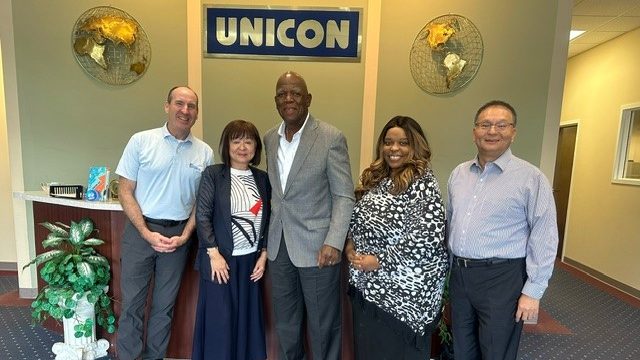
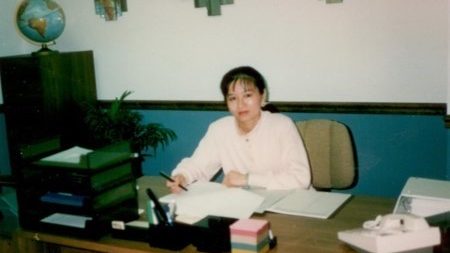
Pei-Chen Jane Lee came to Columbus from Taiwan for graduate school, built a career at AT&T Bell Laboratories, and launched UNICON International in 1990. What started as a one-placement-at-a-time IT staffing firm has grown into a full-service provider of workforce staffing, IT solutions, and managed services, with Fortune 500 client relationships spanning more than two decades.

For more than three decades, UNICON International, Inc. (UNICON) has quietly built a reputation as one of Ohio’s most trusted workforce and IT services firms. The company has served clients like American Honda Motor Co.  (Honda) and American Electric Power (AEP) for over two decades, won multiple OMSDC awards, and evolved from a specialized IT staffing firm into a full-service provider of workforce staffing. IT solutions, and managed services.

Behind that growth is founder Pei-Chen Jane Lee (Jane), an immigrant from Taiwan. She came to Columbus Ohio for graduate school with nothing but a dream and began her career at AT&T Bell Laboratories.  On the first day of her first job, her assigned mentor told her he couldn’t understand her English. He had been one of the people who interviewed and hired her for the job. “I was crushed,” Jane recalls. She stopped asking him questions after that. But by the end of that first year, the same mentor asked Jane to review his performance write-up before he submitted it. “I was shocked,” she says. “But at the same time, I felt flattered.”

There was also the co-worker who told her, “If you don’t like it here, go back to where you came from.” and later remarked, “You Asians are going to take over AT&T.” Jane looked around her work location. There were fewer than a dozen Asian Americans there. “Not until the day I become President of AT&T,” She replied calmly.

Those moments didn’t break Jane. Instead, they set her trajectory. “Very early on in my career, I set my goal,” Jane says. “I really wanted to prove to people that we, as minorities and women, can do an equally good job, if not better.”

She’s spent her entire career doing exactly that.

Five years after joining AT&T Bell Laboratories, Jane became the first Asian woman promoted to Technical Manager at her location. She managed large-scale real-time telecom projects and was eventually handed supplier management responsibilities on top of her technical leadership role. That dual assignment gave her something most founders don’t get before launching a business: an operator’s view of what a good supplier looks like from the buyer’s chair. She saw what clients needed and what suppliers often failed to deliver. And she started thinking she could do it better.

When AT&T Bell Laboratories later offered employees a special leave-of-absence program, two years with insurance and a held position, Jane initially thought she’d take six months off. She had two young children. The pace of corporate life had become relentless. But once she started exploring the idea of starting her own company, the possibilities took over. She used the full two years of leave. And she never went back.

In 1990, Jane officially launched UNICON as a lean IT staffing firm, built by technical engineers and managers from Bell Labs. They knew how to recruit technical talent because they were technical talent. The early model was deliberately low-risk: IT staffing, one placement at a time.

Then clients started asking for more. Project-based work came first. Then managed services. Then professional services, a category Jane initially resisted because it sat outside UNICON’s core IT identity. But the logic was hard to argue with. “We use recruiters internally. We use administrative staff. We know how to find those people,” she recalls. The expansion into professional services proved to be a success.

UNICON’s client relationships are long-term. Honda has been a client for more than twenty years. AEP, the same. Contracts like those are renewed year after year because UNICON keeps earning the work. In a services business where switching costs are low and competitors are always calling, two-decade relationships are the strongest proof of performance a company can offer.

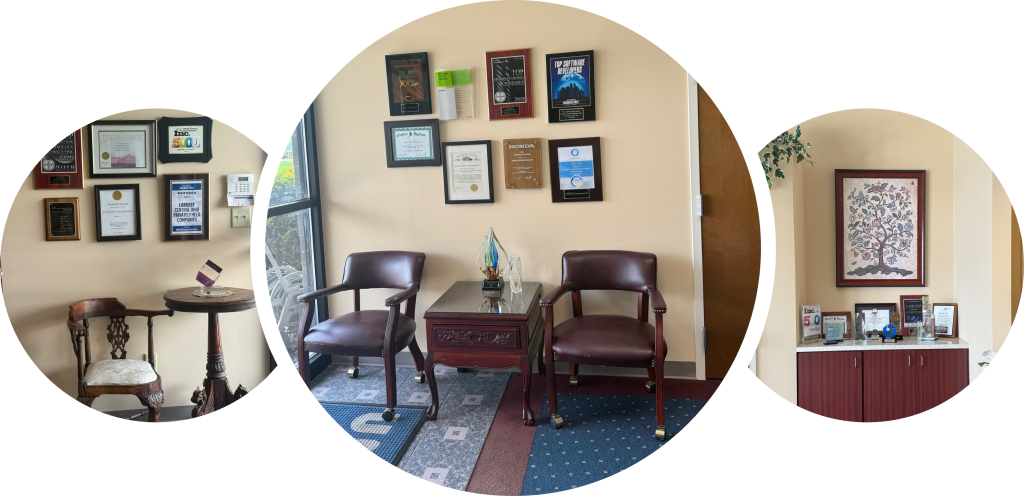
The recognition and awards followed. Over the years, Jane and UNICON have received numerous honors, including five or six from the Ohio Minority Supplier Development Council (OMSDC) alone. Yet for Jane, the awards themselves were never the most meaningful part of the journey. In fact, when George Sims, OMSDC’s President and CEO, encouraged her to apply for MBE of the Year, her first instinct was to step aside. “We’ve won too many awards,” she told him. “I want to give the opportunity to other newer MBEs.” Sims looked at her like she was kidding. She applied. She won. Again.

But what shaped Jane’s thinking about OMSDC wasn’t the trophies. It was a program called the Center of Excellence, chaired at the time by Abigail Kofete of Cardinal Health, now OMSDC Board Chair. The program paired corporate members with MBE suppliers in a year-long cohort that met monthly, rotating through corporate sites. UNICON was the only firm sponsored simultaneously by two Fortune 500 corporate members – Honda and Nationwide Insurance.

“That program was one of the best I’ve ever attended,” Jane says. The value went far beyond networking. It provided firsthand exposure to how major corporations actually operate: their procurement processes, priorities, expectations and internal language. Meetings were held at the sites of various participating corporate members, where executives often spoke directly with the MBEs. The result was the kind of buyer intelligence that no brochure or networking event can replicate.

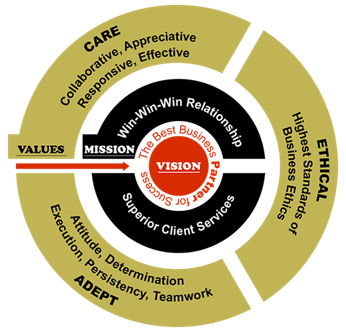
That understanding aligned naturally with Jane’s vision for UNICON: to be the “Best Business Partner for Success” for both clients and associates. Over the years, that philosophy has guided UNICON’s operations and culture. “The extremely positive feedback from our clients, associates and even job candidates made all of our hard work worthwhile,” Jane says.

UNICON’s next chapter is shaped by two forces pulling in different directions. The first is Artificial Intelligence (AI). Jane finds AI both exciting and unsettling. Her VP recently ran an experiment: after UNICON’s team finished a proposal the traditional way, he fed the same requirements into ChatGPT. The AI-generated version was, in her words, “equally good, if not better.”

That raises a question she thinks the entire services industry will have to answer: how do you differentiate a great supplier from someone who’s simply good at prompting?

The other force is legacy. Jane is direct about it. “I’m not getting any younger,” she says. “Before I become history, I hope I can contribute to making some differences.” That ambition extends beyond UNICON itself. She wants to help reshape how MBEs support one another, how corporate members create real opportunities instead of symbolic inclusion, and how organizations like OMSDC can advocate more effectively, especially as the policy landscape shifts.

She’s particularly clear-eyed about the gap between access and outcomes. OMSDC helped open doors by creating introductions and connections, she says. But turning those introductions into sustainable business relationships has always been the harder challenge. Too often, large corporations default to the assumption that bigger suppliers are safer and better suppliers. For MBEs, and for the organizations supporting them, the challenge is building enough proof, enough trust, and enough track records that buyers stop defaulting and start investing in capable local talent.

That’s what thirty-five years of showing up looks like. Not a single breakthrough moment, but a compounding record of delivering the results – over and over again that makes the next conversation easier than the last.

Jane is clear about what comes next. “How can we work together, between MBEs and corporations and organizations like OMSDC, to give every MBE the opportunity to prove themselves?” It’s not a rhetorical question. She’s been answering it for thirty-five years.

Jane’s legacy is clear. Showing up, doing the work, and leaving the door a little wider for whoever walks through it next.

How Can You Support OMSDC in Growing Ohio’s Economy?

If you’re an Ohio-based, minority-owned business ready to compete for larger contracts, or a buyer building a resilient, local supply base, connect with OMSDC. Start with certification, sourcing introductions, and practical guidance on the changing landscape: certification@ohiomsdc.org.

Have a success story you want to share? Email us at marketing@ohiomsdc.org or submit our story form.

From One-Man Shop to Multi-Million Pipeline: How Unified Building Technologies Turns Complex Jobs Into Turnkey Wins—and Community Impact

by Jamie R. Van Doren

Unified Building Technologies launched in December 2023. By Q1 2025, revenue moved from about $60,000 in 2024 to roughly $600,000, with year-end pacing near $850,000 and $6 million in projects in the near pipeline. Unified Building Technologies became an OMSDC-certified MBE in April 2025 and immediately sponsored ConnectingOHIO.

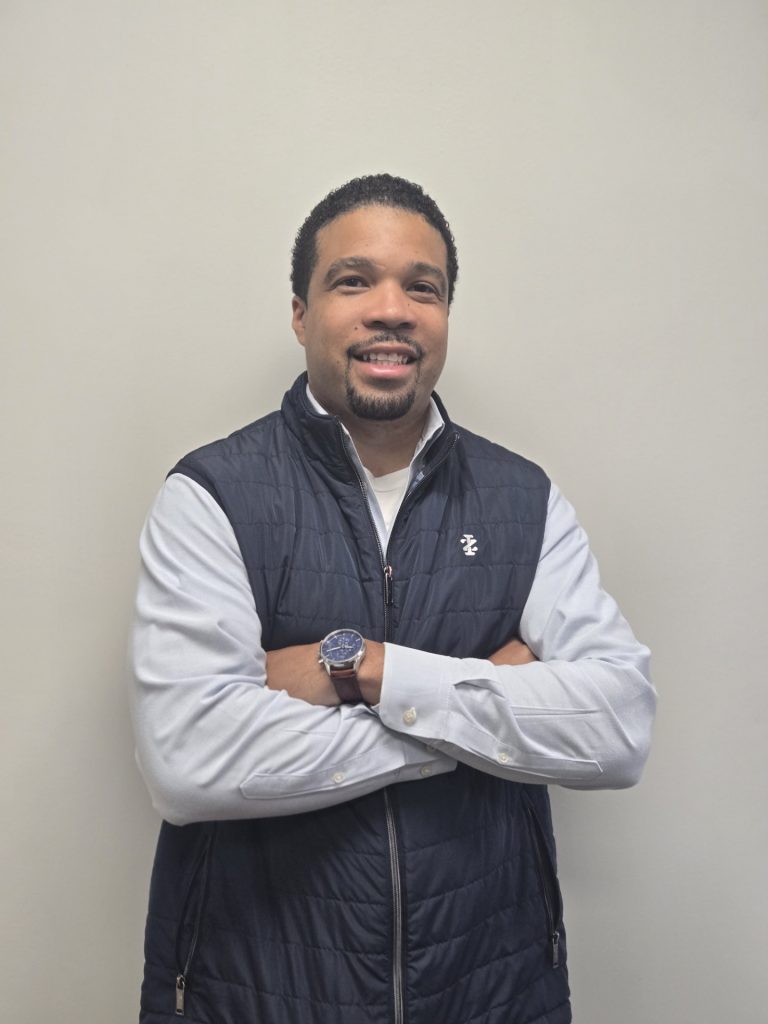
The water in Kingman, Arizona, came out at ninety-five degrees, but the plants needed sixty-eight. A horticulture facility had the wells, the RO system, and the ambition—just not the cooling. When John Ramos stepped in, he didn’t just reach for a catalog SKU. He designed a solution.

That instinct to craft solutions, not just sales, has been shaped over time. Ramos started in HVAC at Stark State, earning an associate’s degree and the mentorship of two professors who pushed him to master both the technical and business sides of the field. Wholesale distribution followed at Robertson Heating Supply, where he learned how manufacturers think and why projects stall when design and lead times fall out of sync. Those lessons would matter later, when speed and availability became the difference between a fix and a failure.

Wadsworth Solutions drew him closer to the applied side—specification work, engineer relationships, and the kind of open-ended problems that reward initiative. In that “wild west,” as he puts it, Ramos saw a recurring need: owners needed one accountable person to design, procure, coordinate, and deliver. Meeting that need required a new structure and real capital.

With backing from Lion’s Share Company, a legacy Ohio organization, Unified Building Technologies took shape in December 2023. The partnership gave the young firm the scaffolding new contractors often lack—legal, bonding and insurance support, and working capital—while keeping Ramos’ design-build vision at the center. The result is a business that collapses seams. Unified Building Technologies folds engineering, procurement, and delivery under one roof so owners can move from problem to plan without losing time to handoffs.

The numbers tell part of the story. Unified Building Technologies recorded about $60,000 in 2024, then opened 2025 with roughly $600,000 in Q1. Their largest job this year landed around $400,000, and year-end should close near $850,000. Next year could reset the curve. 2026 projects, including an Arizona design-build chiller opportunity, will net them around $6 million, with more even opportunities forming behind it.

For now, scale is intentional and lean and Unified Building Technologies is exploring when and how to expand next. Ramos keeps engineering direction close, sketches solutions before sending them to licensed engineers for the stamp, and maintains direct lines to a few manufacturers for availability intelligence. Subs and partner “muscle” are brought in based on schedule and qualifications. He’s pursuing HVAC and hydronics licensure to bring commissioning and startup in-house. Acquisition is on the table for 2026, once recurring work can support a crew and a management layer. In other words, “crawl, walk, run”—not as a slogan, but as an operating system.

Certification fit that plan. Unified Building Technologies became an OMSDC-certified MBE in April 2025 and, on the same rhythm, stepped in as a ConnectingOHIO sponsor. The point wasn’t a piece of paper to hang on the wall. It was a key to more opportunities. In construction, you often compete with century-old legacy companies. Certification opens doors on the public side and signals credibility. It also plugs you into a network that shares the same goal: building a more resilient Ohio economy. Shortly after, Unified Building Technologies added City of Cleveland and CMHA certifications and won an initial CMHA job around $28,000—an entry made easier by validation and visibility.

The Kingman, AZ job shows how Ramos and Unified Building Technologies pulls these threads together. The owner needed to pull ninety-five-degree water down to sixty-eight on a tight clock. Ramos mapped a chiller strategy that could be built from available equipment and delivered on schedule. He coordinated design, lined up gear, managed subs, and drove commissioning. The fix looks straightforward in hindsight. It rarely does at the start.

ConnectingOHIO 2025 and 2026 extended the same logic to building business relationships. When Ramos decided to attend and sponsor ConnectingOHIO (Columbus, August 4 – 6, 2025) he didn’t expect a one-conversation contract. He went into the room with a plan and a purpose. He accomplished more than expected – leaving with a list of follow ups: primes, city contacts, healthcare systems who might be able to open the right doors at the right time. The challenge now is focus. A small firm can’t chase everything, so Ramos is picking lanes where design-build speed and procurement savvy create an edge. The callback is clear: the work of managing a $400,000 job looks a lot like managing a $4 million job. Coordination scales before headcount does.

Young multiracial people having fun stacking hands outdoor – Diversity and joyful lifestyle concept – Soft focus on african hand

Community impact is built into Ramos’ business model. He serves on four local boards, including United Way’s Community Impact Council, and helps steward a CDC that builds affordable housing for seniors. As Unified Building Technologies grows, that capital—and the jobs that follow—circulates locally. Dollars retained in the region multiply. Dollars that leave drain resources, as community capital flows elsewhere. Ramos, like many who advocate for more minority business investment, recognizes that supplier diversity isn’t charity. It’s how you keep the flywheel turning at home.

Policy shifts are changing the ground under every MBE. Ramos is tracking the moves on disadvantage standards and the downstream changes across cities and state reciprocity. What helps most, he says, is clear guidance and practical tools—especially if owners must document disadvantage narratives under new rules, like the Department of Transportation’s changes to Disadvantaged Business Enterprise definitions. Continued advocacy matters too, not only with government but with private buyers who still care about equity and need qualified suppliers to perform. The throughline for Unified Building Technologies’ remains: success depends on clarity, speed, and the right partnerships.

What should other MBEs take from Unified Building Technologies’ path? You don’t need a large payroll to start winning larger scopes. You need a clear value proposition, partners willing to share risk and support you, and a network (like OMSDC’s) that opens rooms you can’t open alone. Certification and event aren’t paperwork and parties. They’re how you gain credibility, build relationships, hear about a bid opportunity—and sometimes how you just get your foot in the door.

Ramos wrote a sponsorship check for ConnectingOHIO the moment his OMSDC certificate arrived because he sees the loop. “This community helps me grow, and I want my growth to help the community,” he says. “Let’s grow each other.”

How Can You Support OMSDC in Growing Ohio’s Economy?

If you’re an Ohio-based, minority-owned business ready to compete for larger contracts—or a buyer building a resilient, local supply base—connect with OMSDC. Start with certification, sourcing introductions, and practical guidance on the changing landscape: certification@ohiomsdc.org.

Have a success tory you want to share? Email us at marketing@ohiomsdc.org or submit our story form.